
Trading Execution Best Practices
By Eric McArdle on Jan 13, 2026
The following discussion is provided for general educational purposes only. It is intended to explain common execution concepts that may be relevant if and when an investor chooses to trade. It does not encourage trading activity, trading frequency, or any particular strategy, and it does not constitute investment advice or a recommendation to enter into any transaction.
Good trading, like good driving, depends on preparation, awareness, and disciplined execution. Market conditions can change quickly, and execution quality is often determined by operational details—order types, pricing decisions, liquidity, timing, and risk management. These considerations apply across asset classes, including stocks, options, and exchange-traded funds (ETFs).
Understanding Order Types
Each order type serves a specific purpose and can materially affect execution outcomes.
-
Limit orders provide price control. Buy limits are often placed between the midpoint and the ask, while sell limits are typically set between the midpoint and the bid.
-
Market orders prioritize immediacy but may result in less favorable prices, particularly in wider-spread or volatile markets.
-
For multi-leg strategies, entering all legs as a single order helps ensure the position is executed as intended.
-
Clearly identifying whether an order is opening or closing a position helps reduce operational errors.
These principles apply to ETF trading as well. While many ETFs are highly liquid, others—such as niche, thematic, fixed-income, or international ETFs—may trade with wider spreads and benefit from careful order placement.
Use the Midpoint as Reference
Bid-ask spreads vary widely across instruments. Options and less liquid stocks often display wider spreads, but ETFs can also exhibit meaningful spread differences depending on structure and market conditions.
Referencing the midpoint of the spread can help target more competitive pricing. If a buy limit does not fill, prices can be adjusted gradually toward the ask; similarly, sell limits can be adjusted toward the bid. While crossing the spread may improve execution speed, it can also increase transaction costs relative to midpoint pricing.
For ETFs, it is also useful to be aware of the underlying basket. Even if an ETF’s quoted trading volume appears modest, tight execution ..may still be possible, particularly when underlying holdings are liquid and market makers can hedge efficiently.
Consider Market liquidity
Execution quality is closely tied to liquidity. Large-cap stocks, actively quoted options, and heavily traded ETFs typically have narrower spreads, while thinly traded instruments often have wider spreads.
ETF liquidity should be evaluated at two levels:
-
ETF-level liquidity, reflected in bid-ask spreads and quoted size.
-
Underlying liquidity, which determines how easily market makers can create or redeem ETF shares.
Open interest alone is not a reliable measure of options liquidity, and ETF share volume alone does not tell the full story. Spread width, quote consistency, and the liquidity of the underlying holdings often provide more meaningful insight into execution conditions.
ETF Liquidity: Myth vs. Reality
Myth:
An ETF must trade a high number of shares each day to offer good execution.
Reality:
ETF trading volume alone does not determine execution quality. Many ETFs with modest daily volume can still trade efficiently if their underlying securities are liquid and market makers can create or redeem shares effectively.
Myth:
Low-volume ETFs are always harder or more expensive to trade.
Reality:
Execution quality is more closely tied to bid-ask spreads, underlying market liquidity, and timing than to headline ETF volume.
Understanding ETF Liquidity in Practice
ETFs differ from individual stocks because they draw liquidity from both the secondary market (trading activity in the ETF itself) and the primary market (the liquidity of the underlying holdings). This structure allows market makers to facilitate trades even when ETF share volume appears low.
As a result, an ETF holding highly liquid large-cap stocks may execute smoothly despite limited visible trading activity. Conversely, an ETF holding less liquid assets—such as small-cap equities, high-yield bonds, or international securities—may experience wider spreads or less predictable execution even if its trading volume appears high.
Rather than focusing solely on ETF volume, investors may benefit from evaluating:
-
Bid-ask spread width and stability
-
Liquidity of the underlying holdings
-
Time of day and market conditions
-
Use of limit orders near fair value or net asset value (NAV)
Be Mindful of Timing
Bid-ask spreads often widen at the market open and near the close, when uncertainty is higher and pricing information is still developing. As the trading session progresses, spreads may narrow as markets stabilize and participation increases.
For ETFs, timing matters not only because of volatility, but also because of underlying market hours. ETFs holding international equities, bonds, or less liquid assets may trade less efficiently when their underlying markets are closed, leading to wider spreads or pricing that deviates from NAV.
When trading during periods of higher uncertainty—such as early morning, late afternoon, or around major news events—thoughtful use of limit orders can help maintain greater control.
Manage Position Size and Exit Planning
Execution and risk management are closely linked. Position size affects how easily an order can be worked within prevailing market conditions. Oversized positions can force unfavorable executions, particularly in less liquid stocks, options, or ETFs.
Stop-loss or stop-limit orders can help define exit parameters in advance, but they should be used with an understanding of liquidity and potential price gaps. In ETFs tracking volatile or illiquid markets, stop orders may trigger executions at prices that differ meaningfully from expectations.
Effective execution sometimes means stepping aside—waiting for clearer conditions when liquidity is thin or orders are not filling as expected.
Final Thoughts
Whether trading stocks, options, or ETFs, execution quality depends on the same core principles: selecting appropriate order types, referencing fair prices, assessing liquidity at multiple levels, choosing the right timing, and managing position size thoughtfully.
ETFs offer efficient access to a wide range of markets, but they are not immune to execution challenges. By applying a structured, disciplined approach to execution, investors can improve their ability to obtain fair fills and maintain control in fast-moving markets.
Read more about Basic Option Strategies
Read more about What Influences an Option's Price
Read more about More Options-based Strategies
Read more about Covered Call vs Put Selling
This material is for educational purposes only and does not constitute investment advice or a recommendation of any security, strategy, or product.
Liquid Strategies, LLC (“Liquid”) is an independent investment adviser registered with the U.S. Securities and Exchange Commission (“SEC”) under the Investment Advisers Act of 1940, as amended. Registration as an investment adviser does not imply a certain level of skill or training. Additional information about Liquid, including our investment strategies, fees, and objectives, is available in our Form ADV Part 2A and Form CRS.
The information provided in this material is for informational and educational purposes only and should not be construed as investment, tax, or legal advice, nor as an offer to buy or sell any security, strategy, or product. The content is provided on an “as is” basis without warranties of any kind. Although the information has been obtained from sources believed to be reliable, Liquid does not guarantee its accuracy or completeness and it may be superseded by subsequent market events or other circumstances. Liquid undertakes no obligation to update or revise any information contained herein.
Options involve risk and are not suitable for all investors. Options can be highly volatile, may lower total returns, and even well-structured strategies may result in losses due to market conditions or unforeseen events. Short options strategies involve substantial risk and may expose investors to significant or unlimited losses. Before trading options, investors should carefully review and understand the disclosure document Characteristics and Risks of Standardized Options (ODD), available at www.theocc.com or from your broker.
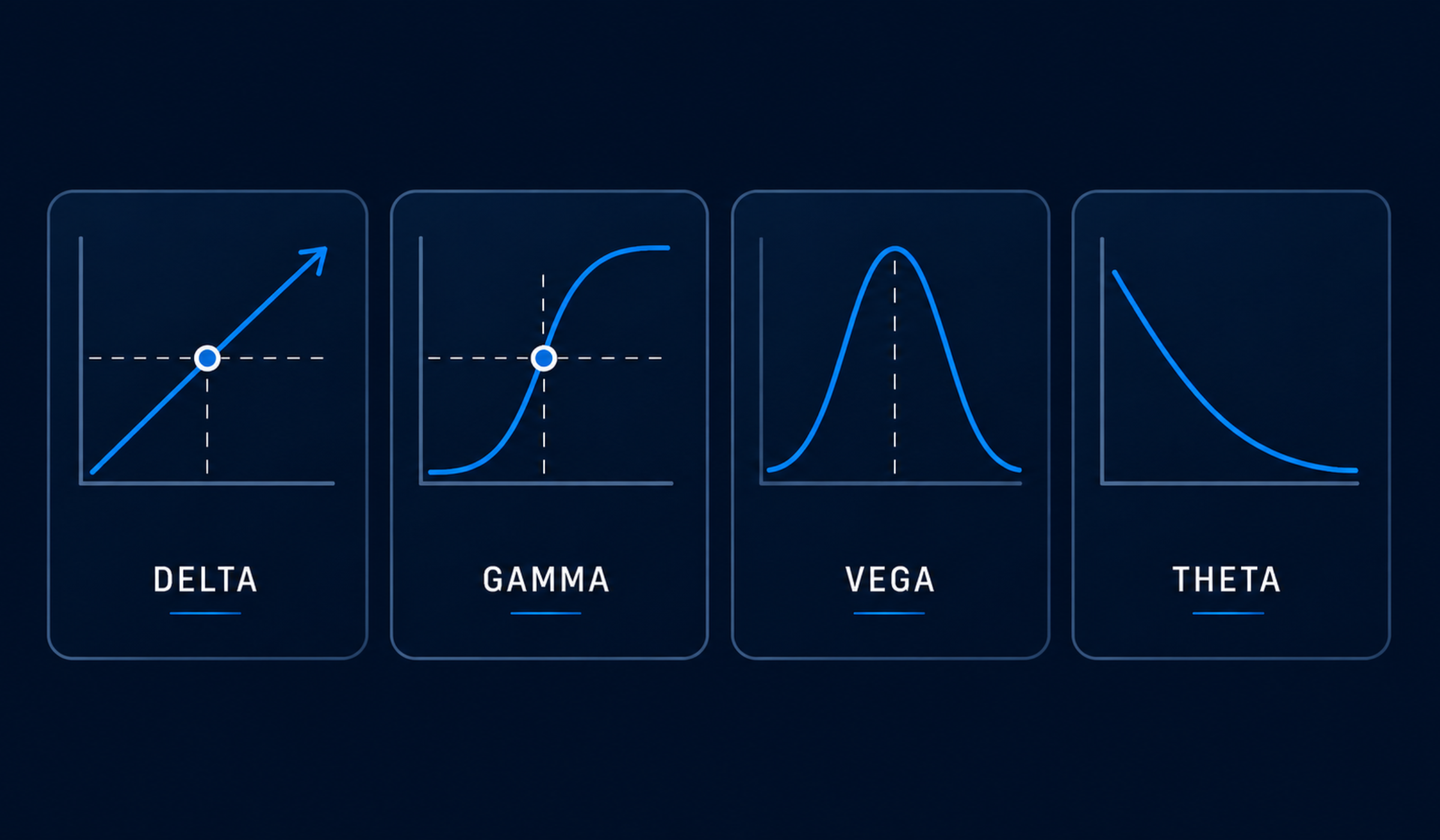
Educational discussions of strategies—including covered calls, put selling, spreads, protective options, volatility strategies, or execution methods—are intended to illustrate general concepts only. These descriptions are not recommendations, and actual performance will vary depending on market conditions, liquidity, transaction costs, and individual circumstances. Analytical measures and sensitivities such as delta, gamma, theta, and vega estimate sensitivity to inputs but do not predict future results.
Applying these considerations does not guarantee favorable execution or investment outcomes
Analogies are simplified illustrations intended to help explain options concepts. They may not reflect all risks, characteristics, or market behaviors associated with actual trading or investment strategies.
Investing involves risk, including the potential loss of principal. Past performance is not indicative of, and does not guarantee, future results. No representation is made that any strategy will achieve profits or prevent losses. Investors should consult with qualified financial, legal, and tax professionals before implementing any investment strategy.
© Liquid Strategies, LLC. All rights reserved. Not for further distribution without prior written consent.
You May Also Like
These Related Stories
.png)
What Influences an Option’s Price
What are Greeks?