
By Shawn Gibson on Mar 04, 2026

Headline index volatility can sometimes mask what is happening underneath the surface of the market. While recent realized volatility for the S&P 500 (SPX) remains relatively contained — with 20- and 30-day historical volatility in the low-teens — the volatility of the underlying constituents tells a different story.
Currently:
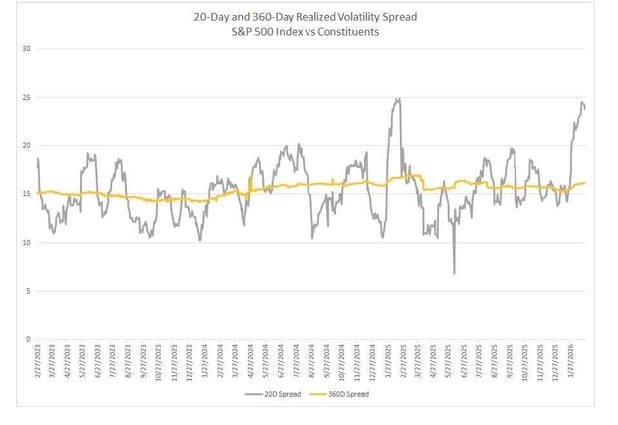 Realized volatility is the statistical measure of the magnitude of past price changes, usually calculated as the standard deviation of returns over a given time window. 20-day realized volatility measures how much the market has moved over the past month. 360-day realized volatility measures how much the market has moved over roughly the past year | Source: LiveVol as of 2/27/2026
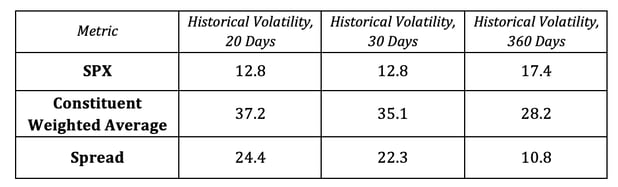 Constituent Weighted Average: Weighted average volatility of the index’s individual stocks. | Spread: Difference between constituent volatility and index volatility | Source: LiveVol as of 2/27/2026
It is common for individual stock volatility to exceed index volatility. Diversification naturally dampens aggregate movement. However, the magnitude of the current spread between index-level volatility and constituent-level volatility is elevated relative to long-term norms. That widening gap suggests increased dispersion and potentially more fragile index stability than headline numbers imply.
Why this Matters
Index volatility remains low when cross-currents offset one another. Leadership concentration, sector divergence, and stock-specific catalysts can produce elevated single-name volatility without immediately translating into higher index-level realized volatility.
Historically, periods of high dispersion can precede broader index volatility shifts. When dispersion is elevated:
-
Correlations can change quickly.
-
Index stability may rely on a narrower group of leaders.
-
Downside moves can accelerate if leadership falters.
While low index volatility can reduce the apparent urgency for protection, elevated underlying volatility suggests that risk beneath the surface may be building.
The Case for Put Buying in this Environment
Put-buying overlays, such as what is delivered in the Overlay Shares Hedged Large Cap ETF OVLH, are designed to provide defined-risk downside exposure through systematic protective put structures layered on top of core equity allocations.
In periods where index volatility appears subdued but underlying volatility is elevated, the cost of index-level protection may not fully reflect the instability within individual constituents. This dynamic can create a more favorable entry point for defined-risk protection strategies.
A Put-Buying Overlay May Potentially Help:
-
Establish disciplined downside buffers before volatility reprices higher.
-
Reduce reliance on reactive risk management decisions.
-
Provide structural overlays designed to provide defined downside exposure, subject to explicit cost and the potential for reduced upside participation, without abandoning core exposure.
Importantly, the objective is not to forecast a volatility spike. Rather, it is to recognize when dispersion and underlying risk dynamics are elevated relative to headline calm.
Defined Risk Versus Reactive Hedging
When volatility regimes shift abruptly, hedging often becomes more expensive and emotionally harder to implement. A systematic put-buying overlay addresses this behavioral challenge by embedding risk management into the portfolio structure in advance, rather than relying on discretionary timing.
In environments where constituent-level volatility significantly exceeds index volatility, disciplined hedging may help moderate portfolio volatility under certain market conditions — not because a downturn is certain, but because the risk backdrop is less uniform than surface-level indicators suggest.
Portfolio Considerations
For allocators concerned about concentrated leadership, elevated dispersion, or late-cycle stability, incorporating a defined-risk overlay may help balance participation with hedging. The goal is not to eliminate volatility, but to shape the return distribution in a way that may improve portfolio resilience.
Periods of apparent calm can sometimes present structurally attractive opportunities to prepare for variability. Elevated dispersion beneath a quiet index is one such condition that warrants attention.
Risk Factors
Put-buying strategies require the payment of option premiums, which represent an ongoing cost. If markets remain stable or rise, these premiums may detract from overall portfolio returns and may cause the strategy to underperform a comparable unhedged equity allocation. While protective puts are designed to provide defined downside exposure, they do not eliminate losses and may reduce upside participation.
The Fund will invest in put options which are financial derivatives that give buyers the right, but not the obligation, to sell (put) an underlying asset at an agreed-upon price and date. The Fund’s use of options may reduce the Fund’s ability to profit from increases in the value of the underlying asset. The Fund could experience a loss or increased volatility if its derivatives do not perform as anticipated or are not correlated with the performance of their underlying asset or if the Fund is unable to purchase or liquidate a position.
Equity Market Risk. The trading prices of equity securities and other instruments fluctuate in response to a variety of factors.
The Distribution Rate is the annual return an investor would receive if the most recently declared distribution remained the same going forward, that may include option income, dividend and return of capital. The Distribution Rate is calculated by multiplying an ETF’s Distribution per Share by twelve (12), and dividing the resulting amount by the ETF’s most recent NAV. The Distribution Rate represents a single distribution from the ETF and does not represent its total return.
Disclosures
Overlay Shares are bought and sold at market price (not NAV) and are not individually redeemed from the Fund. Total Returns are calculated using the daily 4:00pm EST net asset value (NAV). Market price returns reflect the midpoint of the bid/ask spread as of the close of trading on the exchange where Fund shares are listed. Market price returns do not represent the returns you would receive if you traded shares at other times.
Investors should consider the investment objectives, risks, charges and expenses carefully before investing. For a prospectus or summary prospectus with this and other important information about the Fund, please visit the Documents section of this website or call (866) 704-OVLS. Read the prospectus carefully before investing.
Liquid Strategies, LLC (“Liquid”) is an independent investment adviser registered with the U.S. Securities and Exchange Commission under the Investment Advisers Act of 1940, as amended. Registration as an investment adviser does not imply any specific level of skill or training. Additional information about Liquid, including our investment strategies, fees, and objectives, is available in our Form ADV Part 2A and our Form CRS.
All content is provided on an “as is” basis without warranties of any kind. While the information has been obtained from sources believed to be reliable, Liquid Strategies, LLC does not guarantee its accuracy or completeness, and it may be superseded by subsequent market events or other circumstances. We undertake no obligation to update or revise any information contained herein.
Options trading involves significant risk and is not suitable for all investors. Options can be highly volatile, may lower total returns, and even well-structured strategies may result in losses due to market conditions or unforeseen events. Before engaging in options trading, investors should carefully review and understand the disclosure document Characteristics and Risks of Standardized Options, available at www.theocc.com.
Investing involves risk, including the potential loss of principal. Past performance is not indicative of, and does not guarantee, future results. Investors should consult with a qualified financial and/or tax professional before implementing any investment strategy.
Distributed by Foreside Fund Services, LLC, which is not affiliated with the Adviser.
Put Spread Selling Overlays in Core Bond Portfolios

Uncapped Upside While Hedging Equity Exposure