
By Mark Garfinkel on Mar 05, 2026

Private credit has grown meaningfully over the past decade, evolving from a niche allocation to a core component of many income-oriented portfolios. As the asset class has expanded, so too has the level of scrutiny around underwriting standards, liquidity management, and portfolio construction.
Periods of increased attention are healthy for any market. They prompt investors and advisors to examine where capital is flowing, how risk is being managed, and whether structural protections remain intact.
It is important to recognize, however, that private credit is not monolithic.
The risk profile of a large, sponsor-driven direct lending portfolio can differ materially from that of a diversified portfolio of niche, asset-backed strategies operating in under-banked markets. Similarly, the structure through which private credit is accessed can significantly influence liquidity dynamics and portfolio resilience.
Understanding these distinctions is essential.
Capital Concentration and Competitive Dynamics
A substantial portion of industry capital has flowed toward large, private equity-sponsored borrowers. These transactions often involve widely syndicated loans with multiple institutional participants competing for allocation.
As competition increases, spreads may compress. Structural protections can weaken. Covenant flexibility may expand. Leverage levels may rise.
These outcomes are not inherent to private credit itself, but rather to segments of the market where capital is abundant and transactions are heavily intermediated.
By contrast, smaller and structurally complex lending opportunities — particularly within specialty finance, asset-based lending, consumer finance, and certain real estate credit segments — frequently remain under-banked. These markets often require specialized underwriting expertise and operational capabilities that limit participation.

For illustrative purposes only. The graphic is a conceptual depiction of capital concentration across segments of the private credit market and does not represent actual market data, performance, or risk levels. Characteristics may vary by transaction and market conditions.
In some less crowded segments of the market, competitive dynamics may create opportunities for lenders to negotiate covenant terms, collateralization levels, and structural features that differ from those available in more widely syndicated transactions. However, these characteristics can vary by transaction and market conditions. In our view, these characteristics are intended to support risk-adjusted return potential over time.
Why Structure Matters
Beyond underwriting discipline, vehicle structure plays a meaningful role in how private credit portfolios behave during periods of market stress.
Private investments are commonly accessed through several structures — open-end funds, listed closed-end funds, interval funds, and traditional private funds. While each structure has merits, they differ materially in liquidity mechanics, regulatory framework, and investor alignment.
Interval funds occupy a distinct position within this spectrum.
As 1940 Act-registered vehicles, interval funds provide daily net asset value calculations, 1099 tax reporting, and continuous subscriptions. At the same time, liquidity is offered through periodic repurchase windows — typically quarterly — rather than daily redemptions or reliance on exchange trading.
This framework is designed to better align the liquidity of the vehicle with the liquidity profile of the underlying private investments.1
Unlike open-end funds that must meet daily redemptions, or exchange-traded closed-end funds that may trade at discounts or premiums to NAV, interval funds provide defined and transparent repurchase schedules. Repurchases are generally limited to a stated percentage of net assets per period, allowing liquidity to be planned and modeled rather than managed reactively.
Traditional private funds, by contrast, may involve capital calls, extended lockups, and limited liquidity flexibility.
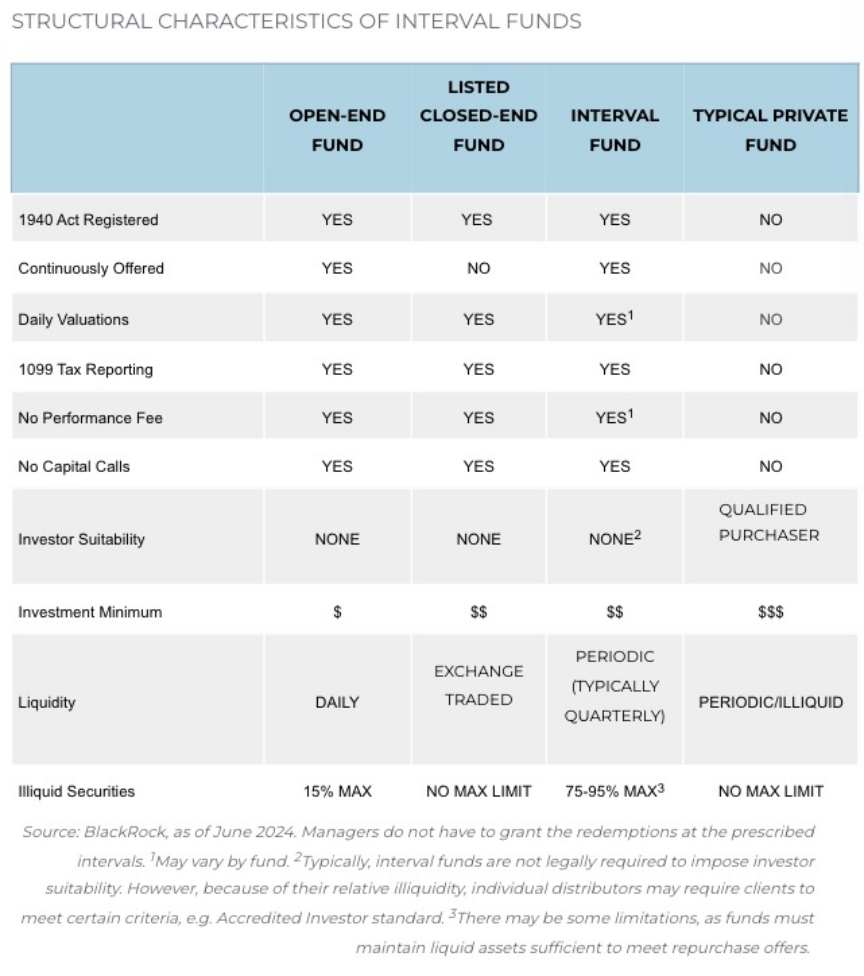
No structure eliminates risk. However, structure influences how liquidity pressures manifest — particularly during periods of elevated volatility.
For portfolios invested in niche private credit strategies, a periodic liquidity framework that is explicitly designed around the characteristics of the underlying assets can provide more prudent alignment between investor expectations and portfolio construction.
A Process Built Around Risk Management
Structure alone is insufficient without disciplined execution.
Our approach to private credit is grounded in three core pillars of risk management:
1. Diversification
We diversify across lending partners, strategies, segments, and individual loans. Concentration limitations are established at multiple levels, and exposures are monitored continuously across portfolio metrics. The objective is to mitigate capital loss risk by avoiding reliance on any single borrower, sector, or strategy.
2. Credit Management
We emphasize senior lending positions and highly collateralized loans. Lending partners undergo comprehensive due diligence, including review of underwriting standards, documentation practices, historical default experience, and recovery outcomes. Structural protections — including conservative loan-to-value ratios and covenant discipline — are central to preserving capital.
3. Liquidity Management
Liquidity management is embedded within the portfolio construction process. We maintain dedicated public market liquidity and emphasize shorter-duration private investments to support quarterly repurchase windows. Cash flow modeling, maturity laddering, and continuous monitoring of liquidity metrics are integral to daily oversight.
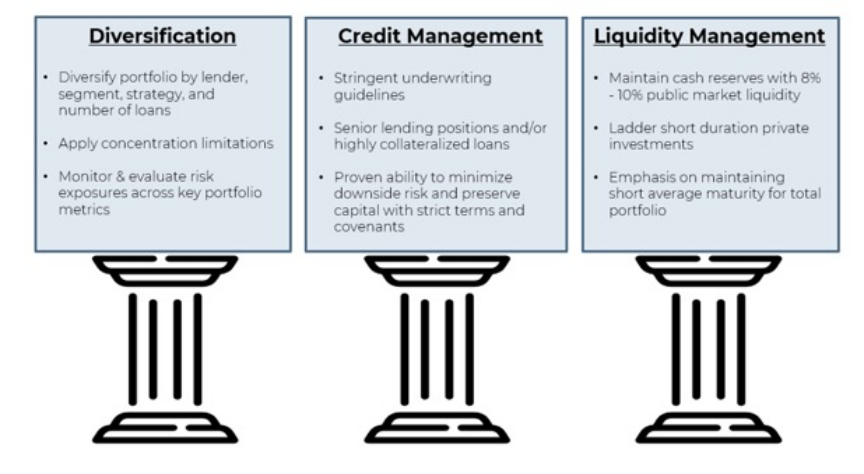
These pillars are not static guidelines. They represent an ongoing process of evaluation, monitoring, and refinement.
Differentiation Within an Expanding Asset Class
As private credit continues to mature, broad generalizations about the asset class may overlook meaningful differences in underwriting philosophy, competitive positioning, and vehicle design.
Large, sponsor-driven lending platforms operate within a distinct competitive dynamic. Niche, under-banked markets present different opportunity sets and risk characteristics. Daily liquidity vehicles face different structural pressures than interval funds designed around periodic repurchase schedules.
For investors and advisors, these distinctions matter.
Private credit can provide attractive income and diversification benefits, particularly when focused on asset-backed strategies with limited sensitivity to traditional public markets. However, outcomes depend on disciplined underwriting, thoughtful liquidity design, and a consistent application of risk management principles.
In private markets, structure and process are not secondary considerations — they are foundational.
1Repurchases may be subject to gating and board approval.
Risks & Disclosures
Although niche and underserved segments of the private credit market may present attractive opportunities, investors should be mindful of the risks associated with these strategies. Key considerations include:
- Borrower Risk in Smaller Companies: Smaller and less established borrowers may have limited operating histories, narrower revenue bases, and fewer financing options, which can increase default risk.
- Specialty Lending Risk: Sectors such as legal finance, factoring, or consumer credit can be highly specialized and subject to unique regulatory, legal, or market developments that may affect performance.
- Collateral and Recovery Risk: While asset-based finance may provide additional security, collateral values can fluctuate and may be difficult to realize in adverse market conditions.
- Liquidity Constraints: Investments in niche private credit often lack secondary markets, making it difficult to sell or exit positions before maturity.
- Valuation Uncertainty: Limited transparency and reliance on manager estimates can lead to valuation challenges, particularly in undercapitalized or less efficient market segments.
- Macroeconomic Sensitivity: Rising interest rates, credit tightening, or economic downturns may disproportionately impact smaller borrowers and specialized lending strategies.
Investors should understand that these risks may result in the loss of principal, reduced income, or delays in expected cash flows. Niche private credit opportunities may complement a diversified portfolio, but they are not suitable for all investors.
Past performance is not indicative of, and does not guarantee, future results. Investors should carefully consider their individual circumstances and consult with a qualified financial professional before making any investment decision or adopting any strategy.
Diversification cannot ensure a profit or protect against principal loss. It is a strategy used to help mitigate risk.
This material is provided for informational purposes only and does not constitute investment advice, a recommendation, or an offer to buy or sell any security. All investments involve risk, including the possible loss of principal. Private credit investments are speculative, may be illiquid.
Past performance is not indicative of future results. Any projections, forecasts, or forward-looking statements are based on assumptions and current market conditions, which are subject to change without notice.
There is no guarantee that projections or forecasts will be realized. Statements regarding expected returns, yields, or outcomes should not be construed as guarantees of performance.
Comparisons to other asset classes or strategies are provided for illustrative purposes only and do not imply that such results will continue or be achieved. Market commentary is based on information believed to be reliable; however, accuracy and completeness cannot be guaranteed.
References to specific strategies or investments are provided for illustrative purposes and do not represent a recommendation. Indices referenced (if any) are unmanaged, cannot be invested in directly, and do not reflect fees or expenses.
Liquid Strategies, LLC (“Liquid”) is an independent investment adviser registered with the U.S. Securities and Exchange Commission under the Investment Advisers Act of 1940, as amended. Registration as an investment adviser does not imply any specific level of skill or training. Additional information about Liquid, including our investment strategies, fees, and objectives, is available in our Form ADV Part 2A and our Form CRS.
Investing involves risk, including the potential loss of principal.

Put Spread Selling Overlays in Core Bond Portfolios

Uncapped Upside While Hedging Equity Exposure