
By Shawn Gibson on Jun 04, 2026

For years, covered call strategies have been used as a practical way to enhance portfolio income while remaining invested in equities. The appeal is understandable: investors collect option premium in exchange for giving up a portion of future upside participation.
But there is an important tradeoff investors should carefully consider.
Long-term equity returns are often disproportionately influenced by relatively short periods of strong market appreciation. Strategies that repeatedly cap upside participation may generate attractive income today, but they can also meaningfully reduce long-term compounding potential.
That distinction is increasingly relevant as investors evaluate the growing universe of option income ETFs and buywrite strategies.
Indexes like the CBOE S&P 500 BuyWrite Index (BXM), which systematically sell covered calls on the S&P 500, and the CBOE S&P 500 2% Out-of-the-Money (OTM) BuyWrite Index (BXY), have historically demonstrated the benefits of option premium generation. But they also illustrate the structural limitations of consistently selling upside exposure.
At Liquid Strategies and across our Overlay Shares ETF suite, we believe investors should fully understand not just how option income is generated, but also what is potentially sacrificed to create it.
Income Generation Comes with Tradeoffs
Covered call strategies are straightforward in design.
An investor owns equities and sells call options against those holdings in exchange for premium income. That premium may help modestly cushion downside volatility and generate distributable cash flow.
But there is no free lunch.
The option premium received comes at the cost of limiting participation in future equity gains above the option strike price.
That tradeoff can become significant during prolonged bull markets or sharp market recoveries.
Historically, buywrite strategies such as BXM — which systematically sell at-the-money calls on the S&P 500 — have often lagged the broader market over long periods because upside participation becomes capped almost immediately.
For investors prioritizing current income, that may be acceptable.
But investors focused on long-term wealth accumulation should recognize that repeatedly surrendering upside participation can materially impact compounded returns over time.
This dynamic is further illustrated by the degree of downside participation historically maintained by covered call strategies during market drawdowns. Since BXM's inception on 9/10/2010, it has experienced an average drawdown of -3.05% compared to the S&P 500 Index's average drawdown of -3.69% — representing approximately 83% downside capture during those periods.(meaning the strategy participated in roughly 83% of the market’s average drawdown).
The Long-Term Impact of Capped Upside
One of the most overlooked realities in investing is how much long-term performance depends on a relatively small number of strong market periods.
Missing or reducing participation during those rallies can have an outsized effect on cumulative returns.
Covered call strategies inherently face this challenge because upside exposure is continuously monetized in exchange for current premium income.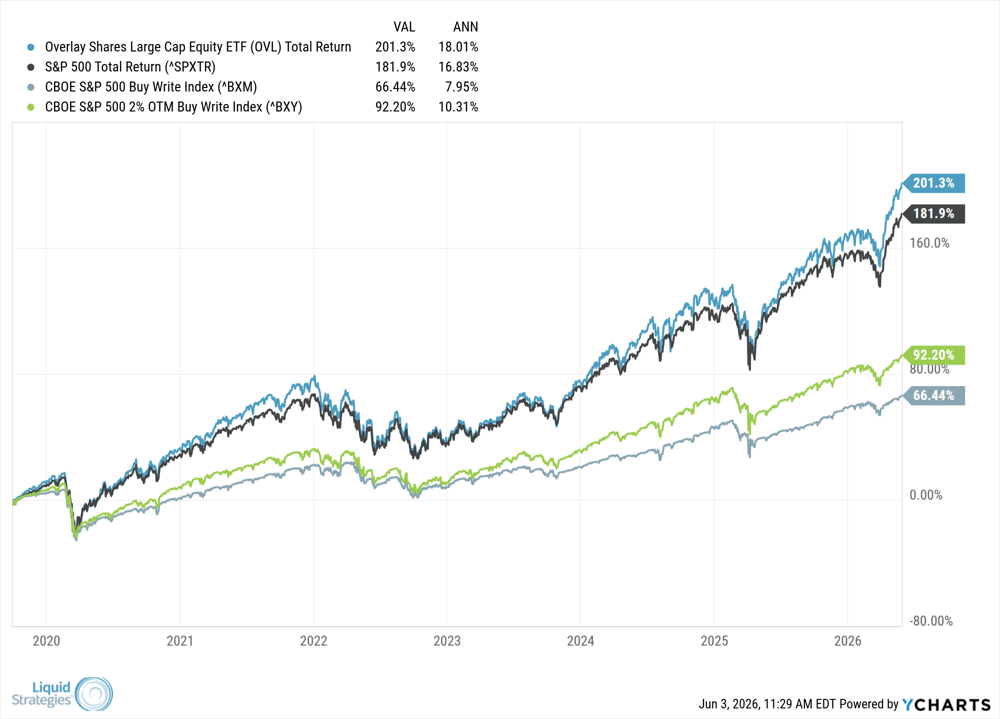
Systematically capping upside participation can create meaningful long-term performance differences.
Source: YCharts | Net of fees
Performance data quoted represents past performance and is no guarantee of future results. Investment return and principal value of an investment will fluctuate so that an investor’s shares, when redeemed, may be worth more or less than their original cost. Current performance may be lower or higher than the performance data quoted. For the most recent month-end performance, please call 1-866-704-OVLS. For standardized performance and expenses visit https://lsfunds.com/ovl
The difference may not always appear dramatic over short periods. But over longer horizons, compounding effects can become substantial.
That is particularly important during secular bull markets where equity appreciation drives the majority of investor returns.
Not All Buywrite Structures are the Same
Importantly, covered call strategies exist on a spectrum.
The traditional BXM structure sells at-the-money calls (with strike prices near current market levels), generating higher premium income but capping upside almost immediately.
Other approaches, such as the CBOE S&P 500 2% OTM BuyWrite Index (BXY), attempt to adjust this tradeoff by selling out-of-the-money calls instead. This allows investors to retain some degree of initial upside participation before gains become capped.
That adjustment can improve participation during moderate market advances.
But the structural tradeoff remains the same:
The strategy still exchanges future upside for present income.
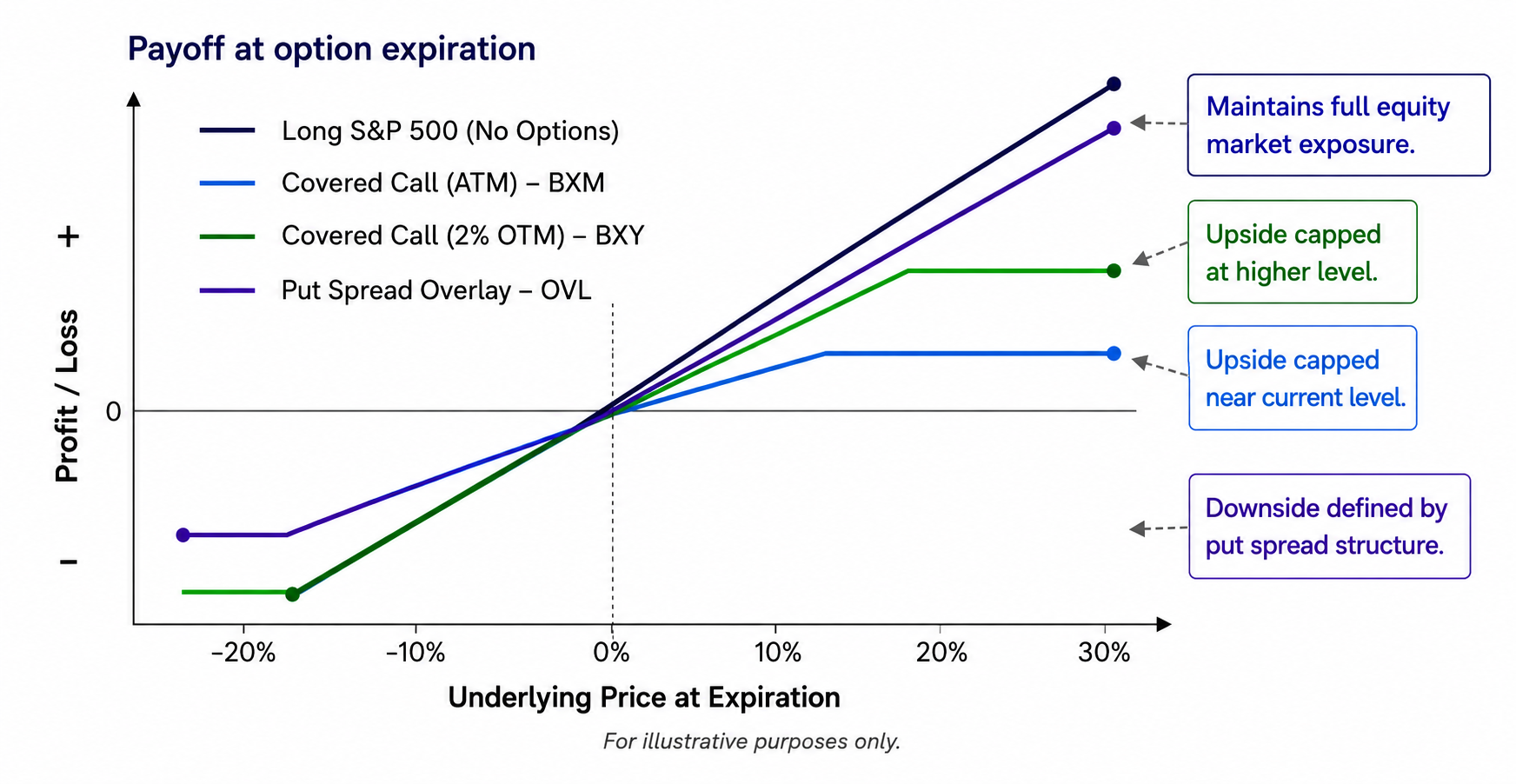
Out-of-the-money covered calls provide more capped upside flexibility, but upside participation remains capped. | Source: Liquid Strategies
The question for investors becomes whether that tradeoff appropriately aligns with their long-term objectives.
Why the Probability Distribution Matters
Historically, the S&P 500 has exhibited a meaningful asymmetry in monthly return outcomes:
|
Monthly Outcome |
Approximate Frequency |
|
Up Month |
~65% |
|
Down Month |
~35% |
|
Up 2% or More |
~39% |
|
Down 2% or More |
~17% |
Monthly S&P 500 total return observations, January 1980 – December 2025 | Source: YCharts.
That distribution matters when evaluating the tradeoffs embedded within different option income strategies.
Traditional covered call strategies — including buywrite approaches such as BXM and BXY — generate option premium by selling upside participation. In exchange for current income, investors may forgo a portion of future equity gains once market returns exceed the call strike price.
Over time, that tradeoff can become meaningful because equity markets have historically experienced strong upside moves more frequently than similarly sized downside moves.
Importantly, long-term equity returns are often disproportionately influenced by relatively short periods of strong market appreciation. Strategies that systematically cap upside participation may therefore create a potential headwind to long-term compounding.
By contrast, put spread overlay strategies seek to generate income from downside volatility pricing while preserving broader participation in long-term equity appreciation.
Covered call strategies primarily monetize upside exposure.
Put spread overlays instead seek to monetize downside risk pricing and investor demand for portfolio protection.
The distinction is important because these approaches harvest different sources of option premium.
Historically, equity index option markets have often exhibited downside volatility skew, where implied downside volatility has tended to exceed subsequently realized downside volatility over time. This dynamic may create opportunities for disciplined option-selling strategies focused on downside risk premiums.
The distribution of market outcomes has also historically been asymmetric.
Historically:
- the S&P 500 has posted monthly gains of 2% or more approximately one-third of the time;
- Monthly declines of 2% or more have occurred less frequently.
Over long investment horizons, those differences may become increasingly important when evaluating strategies that consistently limit upside participation.
A put spread overlay approach seeks to maintain broader upside market exposure while pursuing income generation through downside option structures with defined risk parameters.
For investors focused on balancing:
- income generation,
- equity participation,
- and long-term compounding potential,
The structure of the option strategy itself may matter as much as the income it produces.
A Different Approach to Option Income
At Liquid Strategies and across our Overlay Shares ETF suite, we approach option income differently.
The Overlay Shares Large Cap Equity ETF (OVL) utilizes put spread overlays that seek to generate income while maintaining broader participation in the equity performance of the underlying U.S. large cap equity portfolio. This same concept is applied to foreign equities and small cap equities via OVF and OVS, respectively.
Rather than selling upside exposure through covered calls, OVL seeks to monetize downside volatility through put spread positioning beneath the market.
Covered call strategies generate income by selling away future upside participation.
Put spread overlays instead seek to generate premium from downside risk pricing while seeking to maintain participation in long-term equity performance.
In practical terms:
- Covered calls monetize upside potential
- Put spread overlays monetize downside risk pricing and investor demand for protection
Those are fundamentally different sources of option premium.
And over long investment horizons, the source of return matters.
Put spread overlay strategies involve their own tradeoffs and risks. During sharp or prolonged market declines, investors may be exposed to losses on both the underlying equity portfolio and the put spread positions potentially resulting in greater downside participation compared to covered call strategies, which generate offsetting premium from upside exposure. Income generation may also vary depending on volatility conditions and option pricing dynamics. While seeking to maintain equity participation may support long-term compounding potential, investors should recognize that no option structure eliminates equity market risk or guarantees improved outcomes.
Distributions may include a return of capital, which should not be confused with investment income or yield.
The Behavioral Appeal — and Risk — of High Distribution Rates
Many covered call strategies have gained popularity because their distribution rates can appear highly attractive, particularly during periods of elevated volatility.
Monthly income is tangible. Investors naturally value cash flow consistency.
But high distribution rates should not be confused with superior total return outcomes.
In some cases, a strategy generating elevated distributions may simultaneously experience slower net asset value growth due to persistent upside limitations.
A portion of distributions in some option income strategies may also reflect the monetization of future equity participation rather than incremental portfolio return.
That does not make covered call strategies inappropriate. For some investors, prioritizing current income may be entirely reasonable.
But investors should clearly understand the tradeoff they are making.
The key question is not simply:
“How much income does this strategy generate?”
The more important question is:
“What source of return is being sacrificed to create that income?”
Why Structure Matters
Option income strategies are ultimately tools for reshaping the risk-and-return profile of an equity portfolio.
Different structures create different tradeoffs.
Traditional buywrite indexes such as BXM and BXY may appeal to investors seeking enhanced income and potentially lower volatility. But they do so by systematically reducing participation in future market upside.
OVL seeks to approach income generation differently — by seeking to maintain broader participation in equity performance while also seeking to monetize downside volatility pricing through put spread overlays.
For investors who value both income generation and long-term compounding potential, that distinction may become increasingly important over time.
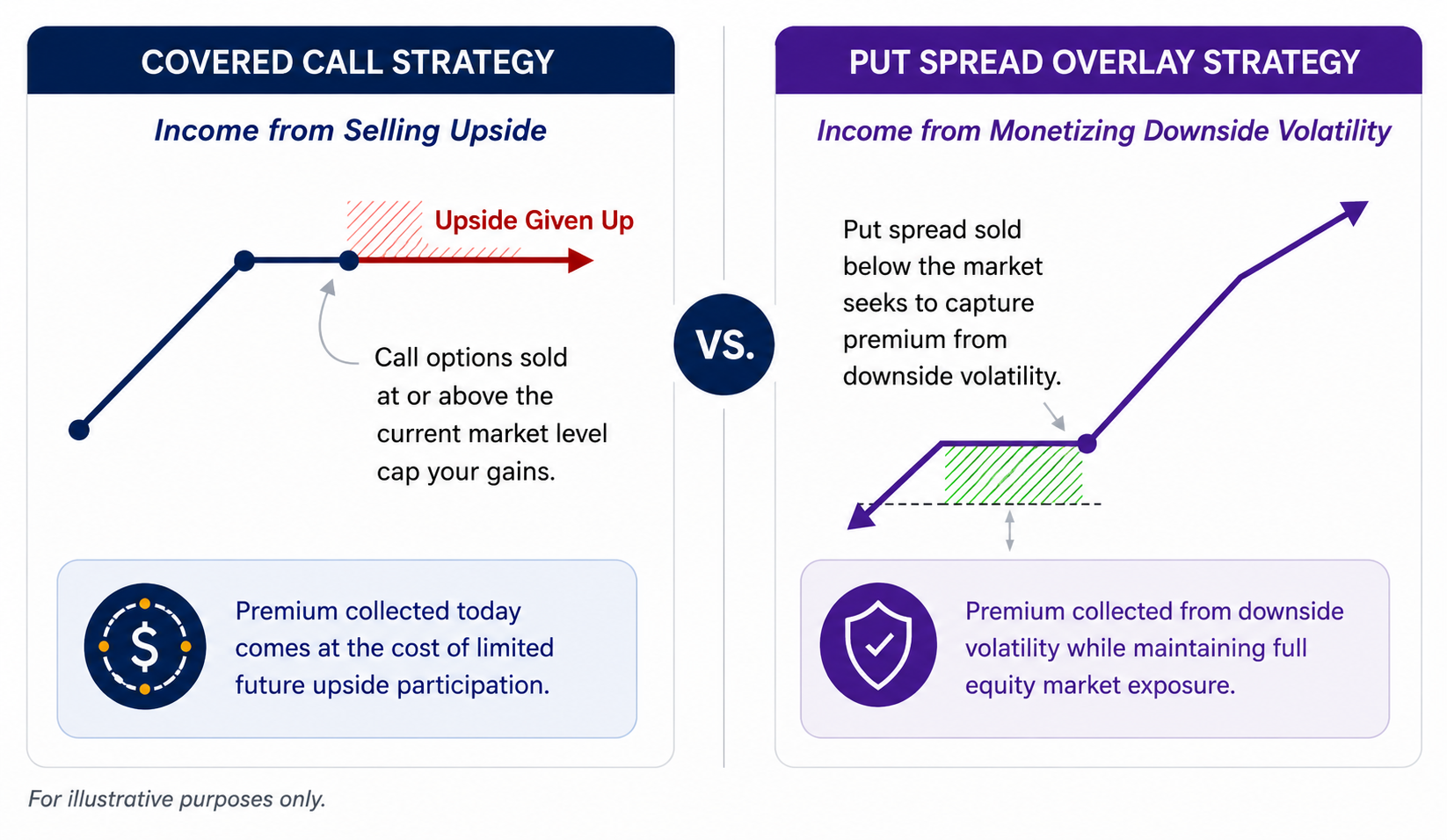
The structure of an option strategy determines where income comes from — and what investors may give up in return. | Source: Liquid Strategies
Over long investment horizons, the structure of an option strategy may meaningfully influence not only the income investors receive, but also the growth potential they retain. This emphasis on total return is what drives the investment process behind the Overlay Shares ETFs.
Disclosures
Options strategies involve risk, including the potential for significant losses. Putwrite and put spread strategies may lose more than the premiums received, particularly in sharply declining markets. Premium income is not guaranteed and may vary with market conditions. Past performance of indices or strategies is not indicative of future results. Indexes are unmanaged and cannot be invested in directly. For more information on options: www.theocc.com.
Selling (writing) and buying options are speculative activities and entail greater than ordinary investment risks. The Fund’s use of put options can lead to losses because of adverse movements in the price or value of the underlying asset, which may be magnified by certain features of the options. When selling a put option, the Fund will receive a premium; however, this premium may not be enough to offset a loss incurred by the Fund if the price of the underlying asset is below the strike price by an amount equal to or greater than the premium. Purchased put options may expire worthless and the Fund would lose the premium it paid for the option. The Fund may lose significantly more than the premiums it receives in highly volatile market conditions.
The Fund will invest in short term put options which are financial derivatives that give buyers the right, but not the obligation, to sell (put) an underlying asset at an agreed-upon price and date. The Fund’s use of options may reduce the Fund’s ability to profit from increases in the value of the underlying asset. The Fund could experience a loss or increased volatility if its derivatives do not perform as anticipated or are not correlated with the performance of their underlying asset or if the Fund is unable to purchase or liquidate a position.
Overlay Shares are bought and sold at market price (not NAV) and are not individually redeemed from the Fund. Total Returns are calculated using the daily 4:00pm EST net asset value (NAV). Market price returns reflect the midpoint of the bid/ask spread as of the close of trading on the exchange where Fund shares are listed. Market price returns do not represent the returns you would receive if you traded shares at other times.
Investors should consider the investment objectives, risks, charges and expenses carefully before investing. For a prospectus or summary prospectus with this and other important information about the Fund, please visit the Documents section of this website or call (866) 704-OVLS. Read the prospectus carefully before investing.
Data from third-party sources are believed to be reliable but have not been independently verified.
Liquid Strategies, LLC (“Liquid”) is an independent investment adviser registered with the U.S. Securities and Exchange Commission under the Investment Advisers Act of 1940, as amended. Registration as an investment adviser does not imply any specific level of skill or training. Additional information about Liquid, including our investment strategies, fees, and objectives, is available in our Form ADV Part 2A and our Form CRS.
The information provided on this website is for informational purposes only and should not be construed as investment, tax, or legal advice, nor as an offer to sell or a solicitation of an offer to buy any security or investment strategy. All content is provided on an “as is” basis without warranties of any kind. While the information has been obtained from sources believed to be reliable, Liquid Strategies, LLC does not guarantee its accuracy or completeness, and it may be superseded by subsequent market events or other circumstances. We undertake no obligation to update or revise any information contained herein.
Options trading involves significant risk and is not suitable for all investors. Options can be highly volatile, may lower total returns, and even well-structured strategies may result in losses due to market conditions or unforeseen events. Before engaging in options trading, investors should carefully review and understand the disclosure document Characteristics and Risks of Standardized Options, available at www.theocc.com.
Investing involves risk, including the potential loss of principal. Past performance is not indicative of, and does not guarantee, future results. Investors should consult with a qualified financial and/or tax professional before implementing any investment strategy.
Distributed by Foreside Fund Services, LLC, which is not affiliated with the Adviser.

How Putwrite ETFs Seek Option-Premium Income: A Deep Dive with Overlay Shares

Volatility Beneath the Surface: What Elevated Dispersion May Signal for Put-Buying Overlays