
By Mark Garfinkel on Oct 21, 2026

NIAGARA INCOME OPPORTUNITIES QUARTERLY REVIEW
Dear Investors,
Niagara Income Opportunities Fund completed the third quarter of 2026, posting a net total return of 1.93% for the quarter ended September 30, 2026. At the end of the third quarter, the Fund experienced a redemption of approximately 3.95% of total assets, yet with steady inflows, the Fund’s asset base has continued to grow with AUM increasing from approximately $156 million at the end of the first quarter to $166 million as of June 30 and $179 million at the conclusion of the third quarter. The portfolio management team seeks to deliver steady results for its investors through the execution of our multi-strategy private lending approach.
With this growth, the firm has added resources and depth to the investment team to enhance our efforts of building, managing and maintaining a diversified portfolio of niche private lending strategies. As always, we would like to express our gratitude for the trust and support of all our investors and constituents. We are mindful of the responsibility that trust entails, and it shapes how we approach every decision we make with respect to managing the Niagara Income Opportunities Fund.
Sincerely,
Mark Garfinkel, Connor Allen, and the Liquid Strategies Team
FUND SUMMARY
The Niagara Income Opportunities Fund is a continuously-offered, closed-end interval fund with a primary focus on current income generation through investment in a multi-strategy portfolio of private and public credit investments with high current cash yields. The Fund offers daily subscriptions and will offer to make quarterly repurchases at net asset value.
PORTFOLIO STRATEGY
The private credit space spans a broad spectrum of niche lending opportunities. The Niagara portfolio combines different styles of private niche lending strategies into a single portfolio solution. A top priority for the Niagara portfolio team is risk management across three key pillars: 1) diversification; 2) credit management; and 3) liquidity management. This focus is intended to help the team construct a portfolio with an appropriate balance of income and risk. These risk management practices are intended to mitigate risk; however, they do not eliminate the risk of loss, and the Fund’s performance will vary based on market conditions, credit events, and manager execution.
Diversification: The Niagara strategy is designed to seek to manage portfolio risk through diversification by segment, strategy, and the number of loans across the portfolio. In addition, we establish concentration limitations and monitor and evaluate risk exposures across key portfolio metrics.
Credit Management: The portfolio team invests with lending strategy partners who seek to manage downside risk and emphasize collateral coverage, underwriting discipline, documentation, and other structural protections. The team seeks lending partners that align with our disciplined criteria, including established underwriting guidelines, risk mitigation through collateralization, loan terms and covenants, and a focus on niche, underbanked lending markets.
Liquidity Management: The portfolio team manages portfolio liquidity using a combination of cash equivalents, readily marketable publicly traded securities, and short-duration private investments in order to maintain adequate liquidity. In addition, the team strives to maintain a short average maturity of portfolio investments to provide flexibility with respect to liquidity, while pursuing the strategy’s objective of generating current income. Portfolio liquidity does not represent investor liquidity; Fund shares are not redeemable and are subject to limited quarterly repurchase offers.
PORTFOLIO DEVELOPMENTS
During the third quarter, the portfolio management team executed several transactions representing both the deployment of new capital coming into the Fund as well as the recycling of proceeds from payoffs, paydowns, and income distributions. While our pipeline of investment opportunities remains solid, there were no new strategy partners added to the portfolio this quarter; rather, the team deployed excess cash toward existing investments and a single loan participation. These examples were selected to illustrate portfolio activity during the quarter, not on the basis of performance, and are not representative of all Fund investments; a complete list of portfolio holdings is available upon request:
- Hive Financial Asset (HFSA) => Consumer Lending => one of the Fund’s larger positions
- Setpoint Credit Fund => Asset-backed credit to corporate borrowers in residential real estate liquidity channels
- Chicago Atlantic Credit Opportunities => lower to middle market direct lending
- KiWi Alternative Income Fund => hyper-diversified small business lending portfolio/platform
As noted, the Team also executed a loan participation in a senior-secured bridge loan, secured by approximately 580 acres in Ellis County, Texas, positioned as a powered data-center land development site. Underwritten at a low loan-to-value of less than 10% of the site's estimated value, the investment is structured to provide meaningful collateral coverage, although collateral value estimates are subject to uncertainty and may not be realized upon any default or liquidation. The value case depends heavily on the site's power availability, permitting, scale, and location inside a rapidly developing South Dallas data center corridor. The loan carries a 15-month term and a stated interest rate of 14%, with a contractual minimum interest provision payable by the borrower for the first six months if the property transacts ahead of schedule. This loan illustrates how the Team leverages relationships with existing strategy partners to source lending opportunities.
MARKET OVERVIEW
U.S. equities advanced during the third quarter, but the character of the market changed meaningfully as the period progressed. The S&P 500 Index returned 2.30% for the quarter, bringing its year-to-date return to 12.74%. Unlike the broad advance experienced earlier in the year, market leadership narrowed as sharply higher interest rates began to weigh on investor risk appetite.
The quarter's defining development was the substantial increase in interest rates across the Treasury curve. Resilient economic data, persistent inflation concerns, higher oil prices, and a more hawkish policy stance from the Federal Reserve prompted investors to reassess the likely path of monetary policy. Treasury yields rose sharply across the yield curve, with the 2-year and 10-year yields increasing approximately 72 and 83 basis points1, respectively, during the quarter. The move represented a meaningful repricing of interest-rate expectations and influenced performance across nearly every major asset class.
Inflation remained an important consideration throughout the quarter. Rising oil prices, driven in part by continued uncertainty surrounding the conflict in the Middle East, added pressure to inflation expectations while economic activity remained resilient. Against this backdrop, the Federal Reserve maintained a vigilant posture under new Fed Chairman Kevin Warsh, reinforcing expectations that policy could remain restrictive for longer than previously anticipated.
Fixed-income markets faced a particularly difficult environment. Higher Treasury yields pressured bond prices, and the Bloomberg Aggregate Bond Index returned -3.50% for the quarter. The combination of resilient growth, elevated energy prices, geopolitical uncertainty, and a more hawkish Federal Reserve challenged expectations for near-term policy easing.
Credit markets remained comparatively stable for most of the period. High-yield spreads stayed near historically tight levels, reflecting continued confidence in corporate fundamentals and economic growth. Sentiment weakened late in the quarter, however, as the ICE BofA U.S. High Yield Option-Adjusted Spread widened abruptly by approximately 45 basis points over the course of seven days. The widening appeared consistent with a broader reduction in risk appetite as investors reassessed the potential economic implications of a sustained period of elevated interest rates and the impact of higher borrowing costs on refinancing conditions and corporate credit fundamentals.
The effect of rising rates was also evident in equity-market breadth. During the final five weeks of the quarter, investors moved away from rate-sensitive, consumer-sensitive, and economically sensitive companies. The percentage of stocks trading above their 200-day moving averages declined to levels last observed during the first-quarter market pullback. Performance became increasingly concentrated among larger-cap, AI, and other technology-related companies as the quarter progressed. This divergence was reflected in the performance of the S&P 500 Equal Weight Index, which returned -1.87% for the quarter despite the positive return of the capitalization-weighted S&P 500 Index.
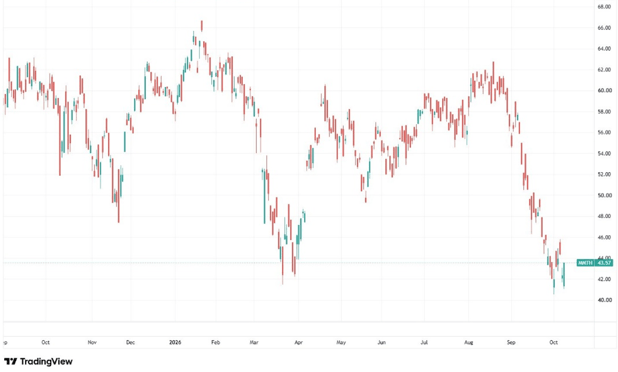
Altogether, the third quarter was defined by the reemergence of interest-rate risk as the dominant influence on financial markets. Economic growth remained resilient, while mega-caps and a select group of technology companies continued to benefit from long-term investment in artificial intelligence and related infrastructure. However, the rapid rise in yields materially narrowed equity leadership, weakened bond returns, and prompted investors to reassess the sustainability of current valuations and growth expectations. The S&P 500 generated a positive headline return, but deteriorating breadth and late-quarter credit weakness reflected growing caution toward the economic implications of a sustained period of restrictive monetary policy.
For the 3rd quarter of 2026, the Niagara Income Opportunities Fund achieved a total return of 1.93% (net of fees), bringing the trailing 12-month total return to 8.42% (net of fees), compared to the Morningstar Leveraged Loan Index performance of 1.95% and 4.56% for the 3rd quarter and trailing 1 year, respectively. The Fund's performance for the quarter fell within our range of expectations and was generally in line with the Morningstar Leveraged Loan Index for the quarter, while comparing favorably over the trailing 12 months. The quarter's backdrop was challenging, given the combination of rising interest rates and the late-quarter widening of credit spreads.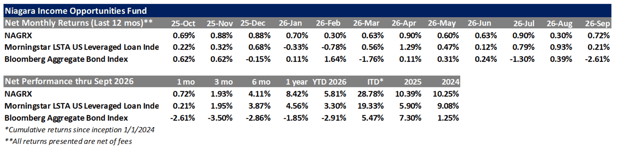
Niagara vs Bloomberg U.S. Aggregate Bond Index2 & U.S. Corporate. High Yield Index3 — Trailing 12 months through September 30, 2026*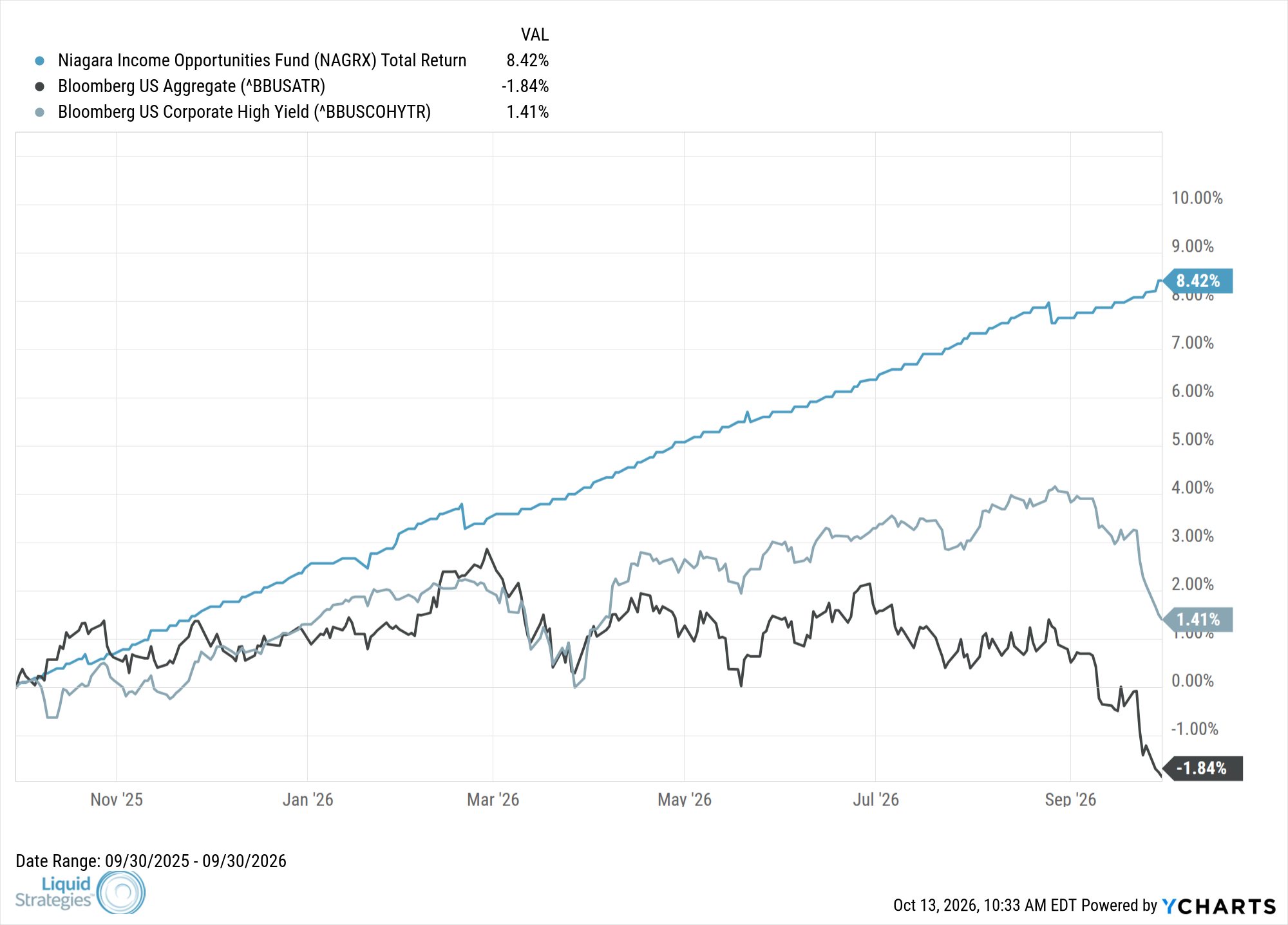 VAL = cumulative total return
Benchmarks are shown for general market context only and are not directly comparable to the Fund due to differences in investment strategy, asset composition, liquidity, risk profile, and fees
*Fund returns are net of fees
An investment in the Fund involves risk, including the possible loss of principal. Past performance is not indicative of future results.
PORTFOLIO MANAGEMENT TEAM COMMENTARY
As of the end of the third quarter, the Fund held approximately 60 private credit investments across 23 different strategy partners. This diversification across multiple investments, private credit asset classes, and strategy partners is a key to managing portfolio risk and a basic tenet of the Fund's approach. As is always the case, the Team continues to focus on those areas of the private credit markets that are less crowded and where access to capital sources is challenging, leading to investments that we believe offer solid risk-adjusted returns.
The Portfolio Team has experienced continued success with Delgatto loan participations, including several loan payoffs or paydowns, some new loan originations, and consistent payment performance on the loan portfolio. This quarter, investments were made primarily with existing strategy partners in an effort to build positions in some of our newer investments, like Setpoint Credit Income Fund, KiWi Alternative Income Fund, and Chicago Atlantic Credit Opportunities, while fortifying positions in our highest-conviction investments, like Hive Financial Asset. Lastly, the Team executed a loan participation with a senior secured position in a bridge loan for a large parcel of land in South Dallas, positioned as a powered data-center land development site. We believe a key factor for this type of project is permitting that enables power to be generated on-site, rather than tapping into the existing power grid.
See Statement of Investments as of 3/31/2026.
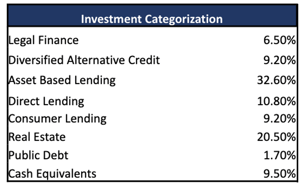
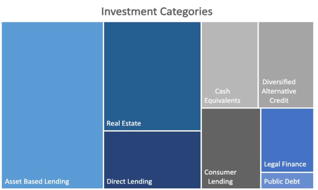
The Team has been conducting enhanced diligence on existing investments to evaluate whether those investments are meeting our objectives and performing to expectations. Where possible and when we identify an investment with a changing risk profile or that is not meeting expectations, the Team will look to reallocate capital across the portfolio in an effort to enhance the risk-adjusted performance of the portfolio. With respect to the Fund's allocation by category, the real estate credit component of the portfolio continues to grow, increasing from 15.5% to 21.0% since the start of the year. Lastly, the Team continues to focus on (i) building a robust pipeline of new investment strategies and opportunities where we can deploy future capital inflows, (ii) monitoring existing investments, and (iii) ensuring appropriate position sizing and portfolio construction.
Our Portfolio Management Team remains squarely focused on the less efficient segments of the credit markets, where we believe lower middle market, niche asset-based, and specialty finance opportunities may offer attractive relative value through reduced competition, stronger documentation, enhanced structural protections, and greater pricing power. This philosophy is reflected in the Niagara Income Opportunities Fund, which employs a multi-strategy approach focused on fragmented lending markets where complexity can create attractive yield opportunities while seeking to mitigate downside risk. We believe specialized platforms with differentiated sourcing capabilities and disciplined risk management are well suited to pursue attractive risk-adjusted returns and current income.
ASSET CATEGORY BREAKDOWN (as of 9/30/2026)
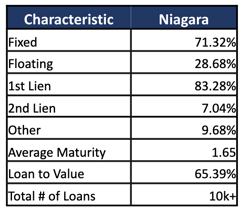
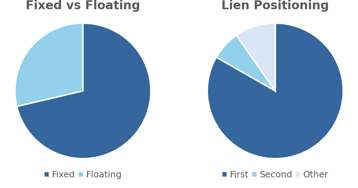
PORTFOLIO CHARACTERISTICS
GROWTH OF $10,000
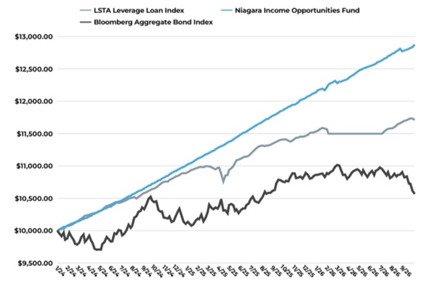
Net of fees | Since inception 12/29/2023 | Past performance is no guarantee of future results
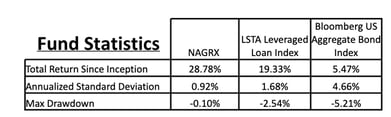
 The Fund also offers quarterly repurchase opportunities subject to applicable terms and fund conditions.
12/29/23 – 9/30/26 | Returns are net of fees
1Basis Point (bp): One one-hundredth of a percentage point.
2Measures the performance of the broad U.S. investment-grade bond market.
3Measures the performance of the broad U.S. high-yield corporate bond market.
DISCLOSURES
Investors should consider the investment objectives, risks, charges, and expenses carefully before investing. For a prospectus with this and other important information about the Fund, please visit LSfunds.com/funds or call 1-800-632-4027. Read the prospectus carefully before investing.
An investment in the Fund’s shares is subject to risks. The value of the Fund’s investments will increase or decrease based on changes in the prices of the investments it holds. This will cause the value of the Fund’s shares to increase or decrease. You could lose money by investing in the Fund. By itself, the Fund does not constitute a complete investment program. Before investing in the Fund, you should consider carefully the following risks the Fund faces, together with the other information contained in the prospectus.
Since the Fund is non-diversified, it is subject to higher reduction of capital and volatility than a fund more proportionately allocated among a large number of securities. An investment in the Fund involves risk. The Fund has a limited operating history by which to evaluate its potential performance. There can be no assurance that the Fund’s strategy will be successful. The Fund may use leverage, including through borrowing. The use of leverage can increase both the risk of loss and the potential for gain.
- Shares of the Fund are not listed on any securities exchange, which makes them inherently illiquid.
There is no secondary market for the Fund’s shares, and it is not anticipated that a secondary market will develop. - Shares of the Fund are not redeemable. Thus, an investment in the Fund may not be suitable for investors who may need the money they invest in a specified time frame.
- Although the Fund will offer to repurchase at least 5% of outstanding shares on a quarterly basis in accordance with the Fund’s repurchase policy, the Fund will not be required to repurchase shares at a shareholder’s option nor will shares be exchangeable for units, interests or shares of any security.
- The Fund is not required to extend, and shareholders should not expect the Fund’s Board of Trustees to authorize, repurchase offers in excess of 5% of outstanding shares.
- Regardless of how the Fund performs, an investor may not be able to sell or otherwise liquidate his, her or its shares whenever such investor would prefer and, except to the extent permitted under the quarterly repurchase offer, will be unable to reduce the shareholder’s exposure on any market downturn.
Private Credit and Liquidity Considerations
Investments in private credit involve risks that differ from publicly traded investments, including limited liquidity, borrower default risk, and valuation uncertainty. Private credit investments may not be easily sold or redeemed, and investors may not have access to capital when desired. Reported valuations may be based on estimated fair value and may not reflect the price at which an investment could be sold.
Past market conditions and performance do not guarantee future results. An investment in private credit may result in the loss of some or all invested capital.
Forward-Looking Statements and Opinions
Certain statements in this commentary reflect the views and opinions of the Adviser as of the date of this letter and are subject to change without notice. Such statements are not intended as investment advice, a recommendation, or a prediction of future market conditions or Fund performance. This commentary may contain forward-looking statements, which are inherently uncertain and based on current expectations and assumptions. Actual results and market conditions may differ materially from those expressed or implied, and undue reliance should not be placed on any forward-looking statements. Past performance is not indicative of future results.
Index and Benchmark Disclosures
Index returns are shown for general market context only. Indices referenced in this commentary, including the Morningstar Leveraged Loan Index, the Bloomberg U.S. Aggregate Bond Index, the Bloomberg U.S. Corporate High Yield Index, the ICE BofA U.S. High Yield Index, the S&P 500 Index, and the S&P 500 Equal Weight Index, are unmanaged and do not reflect the deduction of fees, expenses, or transaction costs. They do not reflect the liquidity constraints, private investment exposure, leverage, or the specific risks associated with the Fund, and are not directly comparable to the Fund due to differences in investment strategy, asset composition, liquidity, and risk profile. Investors cannot invest directly in an index.
Liquid Strategies LLC (“Liquid”) is an independent investment adviser registered under the Investment Advisers Act of 1940, as amended. Registration does not imply a certain level of skill or training. More information about Liquid, including our investment strategies, fees and objectives, can be found in our Form ADV Part 2A and our Form CRS.
Distributed by Foreside Fund Services, LLC, which is not affiliated with the Adviser

NIAGARA INCOME OPPORTUNITIES FUND QUARTERLY REVIEW | As of June 30, 2026

Risk Managing an Evergreen Private Credit Portfolio