
By Mark Garfinkel on Jul 15, 2026
-min.jpg?width=3000&height=2000&name=edward-koorey-Gcc3c6MfSM0-unsplash%20(1)-min.jpg)
NIAGARA INCOME OPPORTUNITIES QUARTERLY REVIEW
Dear Investors,
The Fund completed the second quarter of 2026, posting a return of 2.14% (net of fees). While some interval funds in the private credit and direct lending space experienced significant outflows, Niagara experienced very modest repurchase requests at the June quarterly repurchase window, below the 5% threshold. As a result, the Fund’s asset base has continued to grow with Assets under management (AUM) increasing from approximately $156 million at the end of the first quarter to approximately $166 million at June 30th. The portfolio management team continues to execute our multi-strategy private lending approach with a focus on current income, diversification, and risk management.
With this growth, the firm has added resources and depth to the investment team to enhance our efforts of building, managing and maintaining a diversified portfolio of niche private lending strategies. As always, we would like to express our gratitude for the trust and support of all our investors and constituents. We are mindful of the responsibility that trust entails, and it shapes how we approach every decision we make with respect to managing the Niagara Income Opportunities Fund.
Sincerely,
Mark Garfinkel, Connor Allen, and the Liquid Strategies Team
FUND SUMMARY
The Niagara Income Opportunities Fund is a continuously-offered, closed-end interval fund with a primary focus on current income generation through investment in a multi-strategy portfolio of private and public credit investments with high current cash yields. The Fund offers daily subscriptions and will offer to make quarterly repurchases at net asset value.
PORTFOLIO STRATEGY
The private credit space spans a broad spectrum of niche lending opportunities. The Niagara portfolio combines different styles of private niche lending strategies into a single portfolio solution. A top priority for the Niagara portfolio team is risk management across three key pillars: 1) diversification; 2) credit management; and 3) liquidity management. This focus is intended to help the team construct a portfolio with an appropriate balance of income and risk. These risk management practices are intended to mitigate risk; however, they do not eliminate the risk of loss, and the Fund’s performance will vary based on market conditions, credit events, and manager execution.
Diversification: The Niagara strategy is designed to seek to manage portfolio risk through diversification by segment, strategy, and the number of loans across the portfolio. In addition, we establish concentration limitations and monitor and evaluate risk exposures across key portfolio metrics.
Credit Management: The portfolio team invests with lending strategy partners who seek to manage downside risk and emphasize collateral coverage, underwriting discipline, documentation, and other structural protections. The team is committed to seeking the highest quality lending partners that align with our disciplined criteria, including stringent underwriting guidelines, risk mitigation through excess collateralization and strict loan terms and covenants, and a focus on niche, underbanked lending markets.
Liquidity Management: The portfolio team manages portfolio liquidity using a combination of cash equivalents, readily marketable publicly traded securities, and short-duration private investments in order to maintain adequate liquidity. In addition, the team strives to maintain a short average maturity of portfolio investments to provide maximum flexibility with respect to liquidity, while pursuing the strategy's objective of generating current income.
PORTFOLIO DEVELOPMENTS
During the second quarter, the portfolio management team executed several transactions representing both the deployment of new capital coming into the Fund as well as the recycling of proceeds from payoffs, paydowns, and income distributions. Two new strategy partners were added to the portfolio: Setpoint Capital and Kilgour Williams.
The Setpoint Credit Fund provides short-duration, asset-backed credit to corporate borrowers operating in residential real estate liquidity channels. This includes lending to (i) Power Buyers, which give consumers liquidity solutions to buy a new home before selling their existing home and (ii) Residential Transition Loan Originators, which warehouse and aggregate business-purpose residential loans for sale to institutional buyers such as insurers, pension funds, and securitization channels. Their strategy seeks to generate returns through secured lending spreads, rapid capital velocity, targeted loan-to-value (LTV) ratios, and efficient facility structuring. In addition, their edge is supported by Setpoint’s proprietary technology platform, which integrates with borrower workflows to streamline and automate all aspects of the borrower’s lending operations.
Kilgour Williams is a Toronto-based alternative credit manager focused on small business lending, leveraging fintech origination platforms to gain access to thousands of short-duration loans. Their Fund implements a strategy utilizing their proprietary platform to screen, evaluate, and fund loans originated by their fintech lending partners. The Fund is extremely diversified across 700+ loans at any given point in time across dozens of sub-industries, while maintaining a very short duration profile, which enables monthly liquidity to their investors.
In addition, the Team restructured an existing credit facility with one of our borrowers that not only increased the rate received by the Fund but also enhanced the structure and protections for the benefit of the Fund and our investors.
MARKET OVERVIEW
U.S. equities rebounded sharply in the second quarter, with the S&P 500 Total Return Index up 15.20%, the Nasdaq Composite up 21.60%, and the Dow Jones Industrial Total Return Index up 13.38%. Since the Nasdaq Composite’s history began in 1971, there have been only two prior quarters in which all three indices posted returns above those levels: Q4 1998 and Q2 2020. While Q2 2020 was unique because it followed the global Covid-19 shutdown, Q4 1998 may be the more useful comparison to today’s market environment. In both periods, equities were propelled by enthusiasm around a transformative technology theme: the internet in 1998 and artificial intelligence today. In both cases, investors also largely looked through geopolitical conflict in the Middle East and other macro risks that, in a different environment, could have weighed more heavily on risk assets.
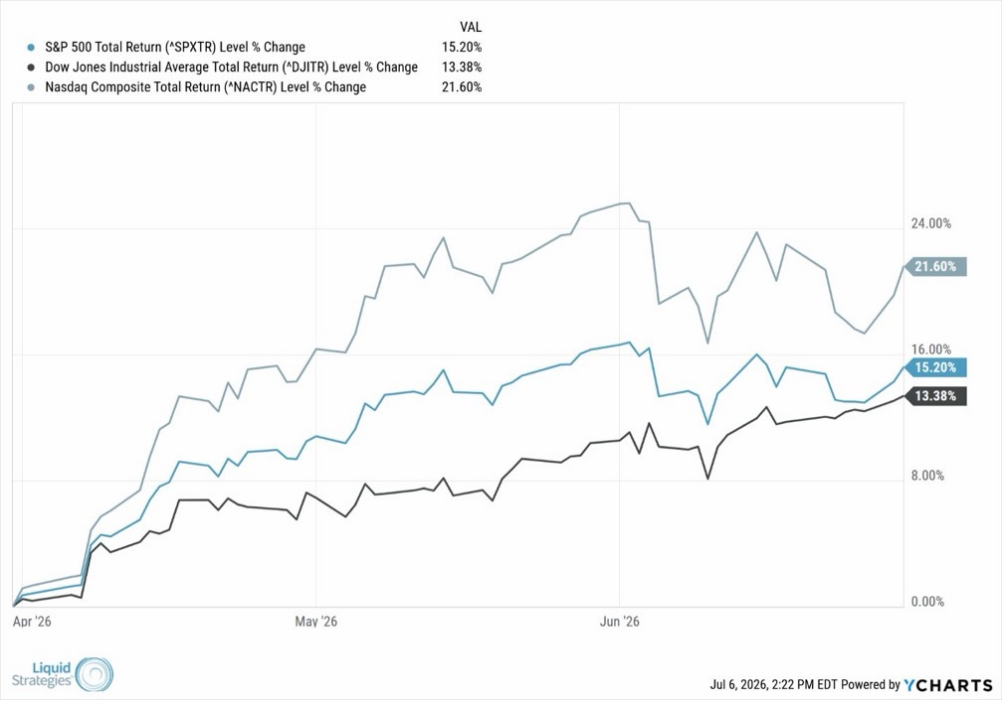
As noted, the AI theme remained the dominant driver of equity leadership in the 2nd quarter. The historic SpaceX IPO further highlighted the market’s appetite for businesses tied to large-scale technological change, while investor enthusiasm continued to extend across AI infrastructure, semiconductors, memory, data centers, and power demand. That said, the size of the AI buildout is also creating questions about sustainability. The largest technology companies are committing enormous amounts of capital to data centers and computing capacity, and investors are increasingly focused on whether future AI-related revenues will justify the current level of spending. We view AI as a major long-term force but also recognize that the pace of investment may eventually slow toward a more rational level.
Inflation concerns re-emerged during the quarter, largely driven by the sharp increase in oil prices earlier in the year following the conflict with Iran and the related disruption in energy markets. Higher energy costs tend to flow through the broader economy because oil is an input into transportation, manufacturing, plastics, and many consumer goods. That dynamic appeared to influence expectations for Fed policy, as market-implied odds of a Fed rate hike in 2026 rose alongside the initial move higher in oil prices. While the ceasefire and signed memorandum of understanding appear to reduce the likelihood of a broader conflict, strains within the Organization of the Petroleum Exporting Countries (OPEC) and the possibility of increased production from certain member countries could further ease supply concerns. As a result, the inflation impact from the earlier oil shock may prove more transitory if energy markets continue to normalize. Even so, investors have been reluctant to fully dismiss the risk of more persistent inflation, which helps explain why market-implied rate-hike odds remained elevated even after crude prices retraced from their peak. This suggests that the market is balancing two competing views: inflation could moderate as the energy shock fades, but the Fed may still need to remain restrictive if the impact proves more durable than expected.
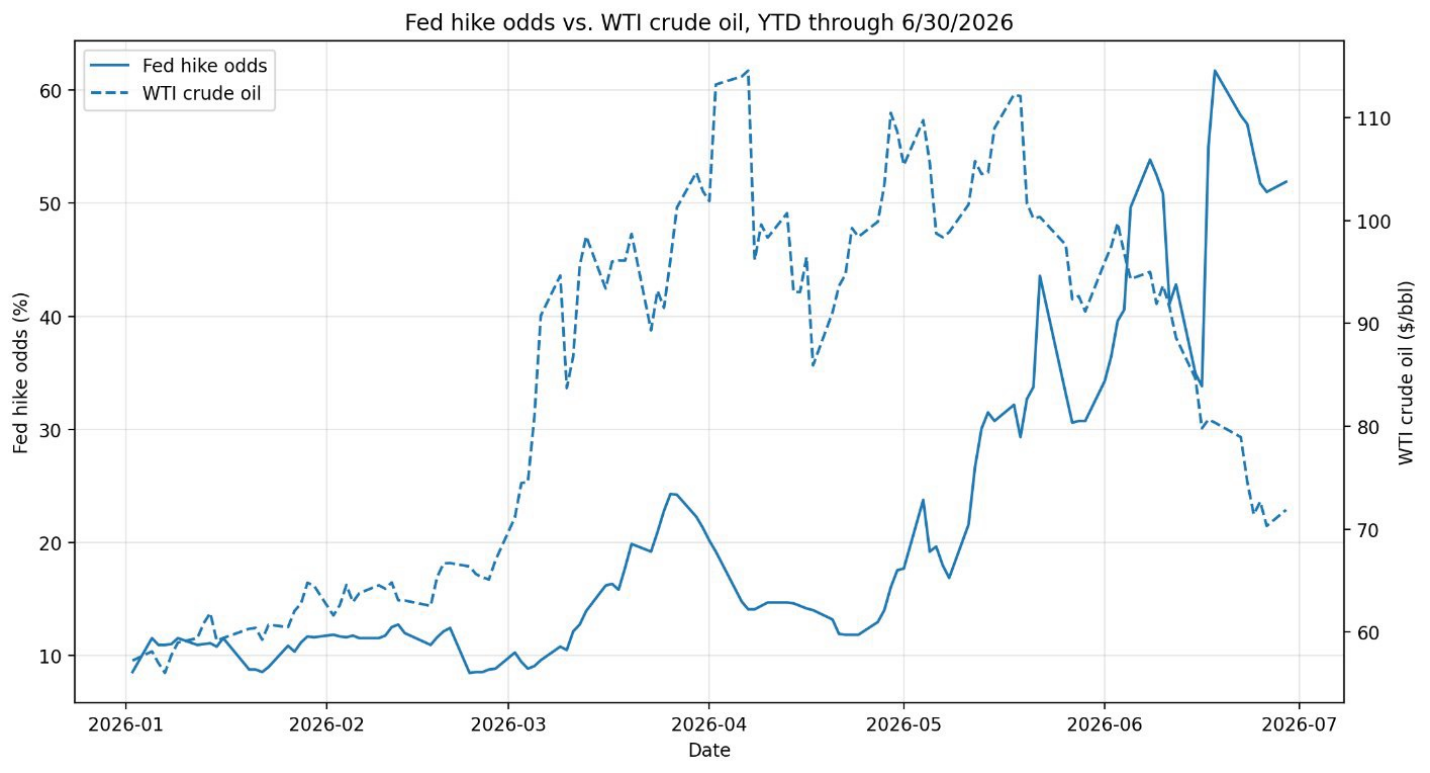
West Texas Intermediate (WTI) crude oil prices and Polymarket-implied odds of at least one Fed rate hike in 2026, January 1-June 30,2026. Polymarket figures reflect market-implied probabilities, not a forecast or a prediction by the Adviser. Past performance is no guarantee of future results.
Fixed income markets reflected the same tension. Treasury yields moved higher across much of the curve during the quarter, with the 2-year Treasury rising from roughly 3.79% to 4.14% from the beginning to the end of the quarter, while the 10-year Treasury increased from roughly 4.32% to 4.46%. The move was likely influenced by a combination of resilient economic data, renewed inflation concerns, geopolitical uncertainty, and reduced confidence that the Fed would be able to ease policy. Credit markets performed better, as risk appetite improved and spreads tightened. The ICE BofA U.S. High Yield Index Option-Adjusted Spread declined from approximately 3.28% on March 31 to 2.75% on June 30, supporting high yield bond returns, despite the move higher in Treasury yields. This was reflected in the quarter’s performance with the Bloomberg U.S. Aggregate Bond Index return of 0.67% lagging the 2.47% return of its High Yield counterpart.
Altogether, the quarter was defined by AI-driven equity momentum overwhelming re-emerging inflation concerns, higher rate expectations, and geopolitical risks. The result was a powerful rally in risk assets, but one that has led some investors to draw comparisons to prior periods of elevated technology-sector enthusiasm and to question the durability of the rally.
PERFORMANCE UPDATE
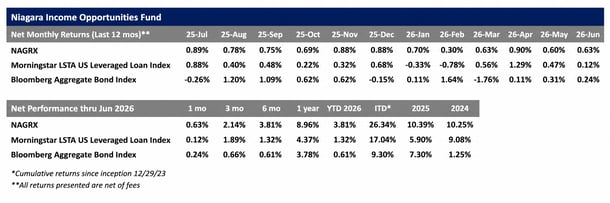
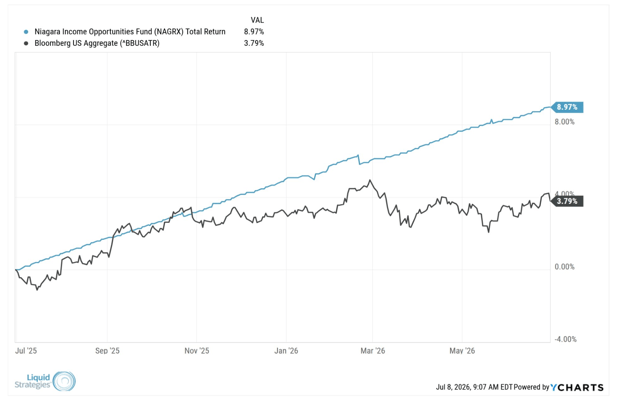
For the 2nd quarter of 2026, the Niagara Income Opportunities Fund achieved a total return of 2.14% (net of fees), bringing the trailing 12-month total return to 8.97% (net of fees), compared to the Morningstar Leveraged Loan Index performance of 1.89% and 4.37% for the 2nd quarter and trailing 1 year, respectively. The Fund’s performance for the quarter fell within our range of expectations and compared favorably to certain referenced private credit and fixed-income market indices. The quarter’s backdrop was broadly constructive, reflected by declining credit spreads as markets recovered from the risk-off conditions experienced during the previous quarter when investor fears were elevated.
Niagara vs Bloomberg U.S. Aggregate Bond Index1 – Trailing 12 months through June 30, 2026*
Benchmarks are shown for general market context only and are not directly comparable to the Fund due to differences in investment strategy, asset composition, liquidity, risk profile, and fees
*Returns are net of fees
An investment in the Fund involves risk, including the possible loss of principal. Past performance is not indicative of future results.
|
|
1 Month |
3 Months |
YTD |
1 Year |
Since Inception (12/29/23) |
|
Niagara Income Opportunities Fund |
0.63% |
2.14% |
3.81% |
8.97% |
26.34% |
|
Bloomberg U.S. Aggregate Bond Index |
0.24% |
0.66% |
0.61% |
3.78% |
9.30% |
PORTFOLIO MANAGEMENT TEAM COMMENTARY AND OUTLOOK
As of June 30, 2026, the Fund held approximately 50 private credit investments across 23 different strategy partners. This diversification across multiple investments, private credit asset classes, and strategy partners is a key to managing portfolio risk and a basic tenet of the Fund’s approach. As is always the case, the Team continues to focus on those areas of the private credit markets that are less competitive and relatively underserved by traditional lenders, leading to investments that we believe offers the potential for solid risk-adjusted returns.
In addition to some of the key portfolio additions noted, including Setpoint Credit Income Fund and KiWi Alternative Income Fund, we have had continued success with Delgatto loan participations with several loan payoffs or paydowns, some new loan originations, as well as consistent payment performance on the loan portfolio. Additional investments were made during the quarter with existing strategy partners, Altriarch (factoring and specialty finance) and RevTek (lower-market direct lending)
The Team has been conducting enhanced diligence on existing investments to ensure that those investments are meeting our objectives and performing to expectations. Where possible, the Team will look to reallocate capital across the portfolio to enhance the risk-adjusted performance of the portfolio. With respect to the Fund’s allocation by category, the real estate credit component of the portfolio continues to grow, increasing from 15.5% to 19.0% since the start of the year. Lastly, the Team continues to focus on (i) building a robust pipeline of new investment strategies and opportunities where we can deploy future capital inflows, (ii) monitoring existing investments, and (iii) ensuring appropriate position sizing and portfolio construction.
Despite recent negative headlines around bank financing, liquidity, software exposure, and redemption pressure, the private credit market remains more nuanced than the media narrative suggests. The asset class has matured into a core allocation, and many private credit vehicles are structured with longer-duration or limited-liquidity features, which may help reduce certain liquidity mismatch risks, although liquidity, valuation, and credit risks remain meaningful across the asset class. While certain risks are real, they are often concentrated in specific areas, particularly covenant-lite, sponsor-driven upper middle market and software-heavy transactions.
This environment is creating greater dispersion across managers and strategies, making disciplined underwriting and portfolio construction increasingly important. Less efficient segments, such as the lower middle market and niche asset-based or specialty finance opportunities, continue to present potential relative value opportunities through reduced competition, stronger documentation, better pricing power, and enhanced structural protections.
This dynamic aligns directly with the positioning of the Niagara Income Opportunities Fund. Niagara’s multi-strategy approach focuses on fragmented, esoteric lending markets where complexity and limited lender participation can create yield premiums and potential downside risk mitigation. As capital becomes more selective, we believe specialized platforms with sourcing advantages and disciplined risk management may be better positioned to identify attractive risk-adjusted opportunities.
ASSET CATEGORY BREAKDOWN
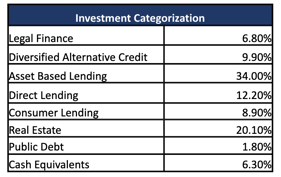
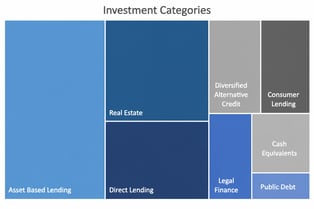
PORTFOLIO CHARACTERISTICS
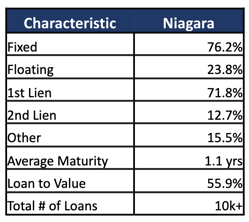
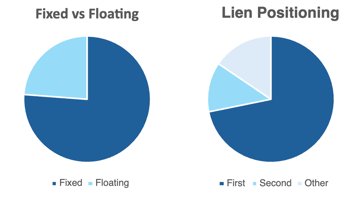
GROWTH OF $10,000
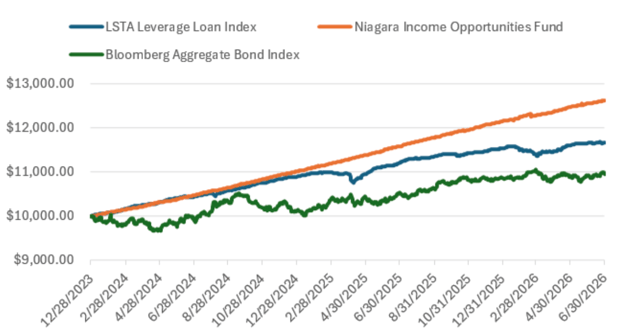
Net of fees | Since inception 12/29/2023 | Past performance is no guarantee of future results
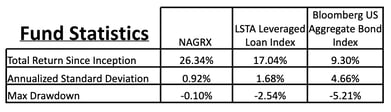
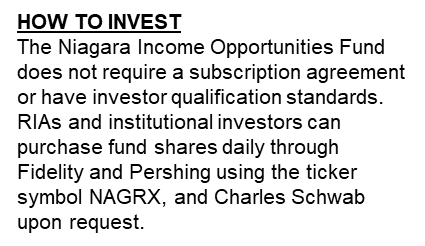 The Fund also offers quarterly repurchase opportunities subject to applicable terms and fund conditions.
12/29/23 – 6/30/26 | Returns are net of fees
1Measures the performance of the broad U.S. investment-grade bond market
Diversification does not assure a profit nor does it protect against loss.
DISCLOSURES
Investors should consider the investment objectives, risks, charges, and expenses carefully before investing. For a prospectus with this and other important information about the Fund, please visit LS funds.com/funds or call 1-800-632-4027. Read the prospectus carefully before investing.
An investment in the Fund’s shares is subject to risks. The value of the Fund’s investments will increase or decrease based on changes in the prices of the investments it holds. This will cause the value of the Fund’s shares to increase or decrease. You could lose money by investing in the Fund. By itself, the Fund does not constitute a complete investment program. Before investing in the Fund, you should consider carefully the following risks the Fund faces, together with the other information contained in the prospectus.
Since the Fund is non-diversified, it is subject to higher reduction of capital and volatility than a fund more proportionately allocated among a large number of securities. An investment in the Fund involves risk. The Fund has a limited operating history by which to evaluate its potential performance. There can be no assurance that the Fund’s strategy will be successful. The Fund may use leverage, including through borrowing. The use of leverage can increase both the risk of loss and the potential for gain.
- Shares of the Fund are not listed on any securities exchange, which makes them inherently illiquid.
There is no secondary market for the Fund’s shares, and it is not anticipated that a secondary market will develop. - Shares of the Fund are not redeemable. Thus, an investment in the Fund may not be suitable for investors who may need the money they invest in a specified time frame.
- Although the Fund will offer to repurchase at least 5% of outstanding shares on a quarterly basis in accordance with the Fund’s repurchase policy, the Fund will not be required to repurchase shares at a shareholder’s option nor will shares be exchangeable for units, interests or shares of any security.
- The Fund is not required to extend, and shareholders should not expect the Fund’s Board of Trustees to authorize, repurchase offers in excess of 5% of outstanding shares.
- Regardless of how the Fund performs, an investor may not be able to sell or otherwise liquidate his, her or its shares whenever such investor would prefer and, except to the extent permitted under the quarterly repurchase offer, will be unable to reduce the shareholder’s exposure on any market downturn
Investments in private credit involve risks that differ from publicly traded investments, including limited liquidity, borrower default risk, and valuation uncertainty. Private credit investments may not be easily sold or redeemed, and investors may not have access to capital when desired. Reported valuations may be based on estimated fair value and may not reflect the price at which an investment could be sold.
Past market conditions and performance do not guarantee future results. An investment in private credit may result in the loss of some or all invested capital.
Forward-Looking Statements and Opinions
Certain statements in this commentary reflect the views and opinions of the Adviser as of the date of this letter and are subject to change without notice. Such statements are not intended as investment advice, a recommendation, or a prediction of future market conditions or Fund performance. This commentary may contain forward-looking statements, which are inherently uncertain and based on current expectations and assumptions. Actual results and market conditions may differ materially from those expressed or implied, and undue reliance should not be placed on any forward-looking statements. Past performance is not indicative of future results.
Index and Benchmark Disclosures
Index returns are shown for general market context only. Indices referenced in this commentary, including the Morningstar Leveraged Loan Index, the Bloomberg U.S. Aggregate Bond Index, and the ICE BofA U.S. High Yield Index, are unmanaged and do not reflect the deduction of fees, expenses, or transaction costs. They do not reflect the liquidity constraints, private investment exposure, leverage, or the specific risks associated with the Fund, and are not directly comparable to the Fund due to differences in investment strategy, asset composition, liquidity, and risk profile. Investors cannot invest directly in an index.
Liquid Strategies LLC (“Liquid”) is an independent investment adviser registered under the Investment Advisers Act of 1940, as amended. Registration does not imply a certain level of skill or training. More information about Liquid, including our investment strategies, fees and objectives, can be found in our Form ADV Part 2A and our Form CRS.
Distributed by Foreside Fund Services, LLC, which is not affiliated with the Adviser

Risk Managing an Evergreen Private Credit Portfolio

DENALI QUARTERLY FUND REVIEW | As of September 30, 2024